meta pixel code

AHC Specialty Clinic


Share on

The Ultimate Guide to Decoding Menopause and Preventing Sudden Cardiac Events

Last updated on April 8, 2026

Why This Topic Matters More Than You Think

Cardiovascular disease is the leading cause of death among women worldwide, more than all cancers combined.

According to the American Heart Association, one in three women dies from heart disease, and many of these cases are preventable with early detection and awareness (https://newsroom.heart.org/news/hot-news-flash-menopause-can-impact-a-womans-heart-health).

The challenge is simple but serious.

Heart disease in women often does not look like heart disease. Symptoms are subtle, confusing, and frequently mistaken for menopause.

The Menopause Transition Is a Turning Point for Women's Heart Health

During reproductive years, estrogen acts as a natural protector of the heart.

It keeps blood vessels flexible, reduces inflammation, and helps maintain healthy cholesterol levels.

But during menopause, this protection declines rapidly.

As supported by research from the American College of Cardiology, heart health can decline significantly after menopause due to vascular stiffness and metabolic changes (https://www.acc.org/about-acc/press-releases/2024/04/01/21/39/heart-health-declines-rapidly-after-menopause).

This is not just a hormonal shift.

It is a cardiovascular shift.

Understanding the Menopause Phases

Menopause is not a single moment. It is a process that unfolds over time.

Perimenopause brings hormonal fluctuations, hot flashes, and sleep disruption.
Menopause is confirmed after 12 months without a menstrual cycle.
Postmenopause represents the long phase where metabolic and cardiovascular risks increase.

The SWAN study shows that women in postmenopause often experience rising cholesterol levels, increased abdominal fat, and higher cardiovascular risk (https://www.swanstudy.org/womens-health-info/cardiovascular-risk-and-heart-health-in-women-during-and-after-menopause/).

Menopause vs. Heart Disease: How to Tell the Difference (Symptom Comparison)

One of the biggest dangers is confusion.

A hot flash can feel intense, but so can a cardiac event.

Here is how to think about the difference:

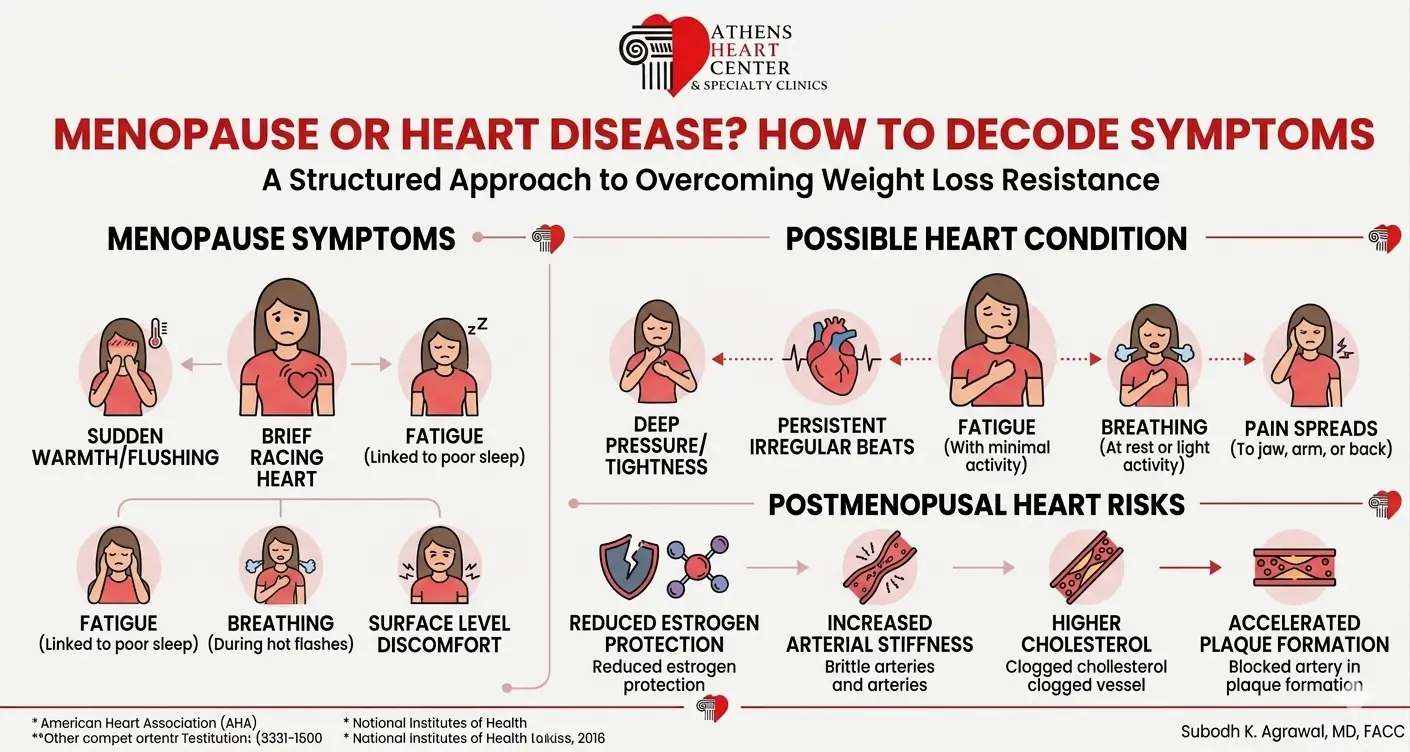
Symptom More Likely Menopause Possible Heart Condition
Chest feeling Sudden warmth or flushing Deep pressure or tightness
Heart rhythm Brief racing feeling Persistent irregular beats
Fatigue Linked to poor sleep Occurs with minimal activity
Breathing During hot flashes At rest or light activity
Pain spread Surface level discomfort Spreads to jaw, arm, or back
If symptoms feel deep, persistent, or spreading, do not ignore them.

Why Cardiovascular Risk Increases After Menopause

After menopause, several important changes occur:
  • Blood vessels lose flexibility
  • Cholesterol levels increase
  • Inflammation rises
Research supported by the National Institutes of Health shows that postmenopausal changes accelerate plaque formation in arteries (https://pmc.ncbi.nlm.nih.gov/articles/PMC12156203/). At the same time, the risk of irregular heart rhythm and stroke increases, especially when combined with poor sleep and metabolic changes.

Athens Heart Center: Integrated Geriatric and Cardiovascular Excellence

Fragmented care is an obsolete model for women navigating the menopause transition. AHC utilizes an advanced integrated specialty care model to prevent postmenopausal women from falling through the cracks of the healthcare system.


Dr. Subodh Agrawal & Advanced Hemodynamic Interventions: With over 45 years of experience, Dr. Agrawal provides elite, board-certified cardiological care. His specialized Concierge Choice Program is designed to give women unhurried, highly personalized annual screening exams and bespoke cardiometabolic wellness plans.


Dr. Aurelio Manto & Comprehensive Metabolic Gerontology: Dr. Manto, uniquely board-certified in Internal and Geriatric Medicine, serves as the critical first line of defense. He oversees osteoporosis prevention and targeted weight loss programs to combat the rapid postmenopausal accumulation of visceral fat (adiposity).

Breakthrough Diagnostic Technologies at Athens Heart Center and Specialty Clinics

Traditional treadmill tests often fail to detect heart disease in women. Athens Heart Center and Specialty Clinics leverages state-of-the-art technology to uncover silent, female-pattern issues:

  1. 1.Nuclear Imaging & High-Def Echo: PET scans visualize the heart’s microscopic blood flow, detecting microvascular disease that other tests miss.
  2.  
  3. 2.Coronary Artery Calcium (CAC) Scoring: A non-invasive scan that measures the exact buildup of plaque, allowing for early, aggressive prevention.
  4.  
  5. 3.Ambulatory Arrhythmia Monitoring: Mobile devices (MCOT) monitor your heart for up to 30 days to catch sporadic, silent irregular heartbeats.

The Role of Hormone Therapy and Modern Medicine

Hormone Therapy

When started at the right time, hormone therapy can support heart health, reduce fat accumulation, and improve overall wellbeing.
Clinical insights from Mass General Brigham suggest benefits when therapy is initiated within ten years of menopause onset (https://www.massgeneralbrigham.org/en/about/newsroom/articles/menopause-heart-disease-hormone-therapy).

Non Hormonal Therapies

For women who cannot use hormone therapy, newer options are available.

Medications such as fezolinetant target hot flash pathways directly.
Emerging therapies also help improve sleep and overall comfort.

Advanced Testing

Many women have conditions that traditional tests may miss.

Advanced imaging helps detect early disease and allows timely intervention.

Lifestyle Still Plays a Powerful Role

Medical treatment is important, but lifestyle is equally critical. At Athens Heart Center, we emphasize:
  • Balanced nutrition inspired by Mediterranean patterns
  • Restorative sleep
  • Regular physical activity
  • Weight and metabolic control
Because prevention is built through daily habits, not just prescriptions.

Self Assessment: 5 Questions Every Woman Should Ask

  1. Does my chest discomfort feel like pressure instead of surface warmth
  2. Does pain spread to my jaw, back, or arm
  3. Do I feel breathless during simple activities
  4. Are my palpitations frequent or unpredictable
  5. Do I feel dizziness, nausea, or sweating together
If the answer is yes to any of these, a cardiology evaluation is important.

Frequently Asked Questions About Menopause and Heart Health

1. Does menopause cause heart disease

No, but it increases risk by removing estrogen protection.

2. Why are heart problems in women often missed

Because symptoms are different and often less obvious than in men.

3. Is hormone therapy safe

It can be safe and beneficial when used correctly and at the right time.

4. Can sleep problems affect the heart

Yes. Poor sleep increases blood pressure and inflammation.

5. Can tests miss heart disease in women

Yes. Some forms require advanced imaging for detection.

6. Are hot flashes dangerous

They are not harmful themselves but may signal increased risk.

7. What is the best way to reduce risk

Early evaluation, healthy lifestyle, and coordinated care.

The Bottom Line

Menopause is not just a hormonal phase.

It is a turning point for heart health.

The symptoms may look similar, but the underlying causes can be very different.

Understanding this difference can protect your health and your future.

Take Action Today

If you are experiencing symptoms or want to understand your risk, do not wait.

Schedule a preventive evaluation with a cardiologist.

At Athens Heart Center, the goal is simple.

Help you live longer and live better.

Share Your Thoughts

No comments yet — be the first to comment!

Leave a Comment

Your email address will not be published. Required fields are marked *

Scroll to Top
Book Appointment