meta pixel code

AHC Specialty Clinic


Share on

The 100-Year Heart: Why Waiting for a Heart Attack is Outdated Medicine

Last updated on April 3, 2026

The era of waiting for a heart attack to happen before taking action is over. Our modern medical system is incredible at saving your life after your artery clogs, but surviving a heart attack transitions you into a lifelong, expensive battle with chronic disease.

If your goal is to live a vibrant, active life to the age of 100, we must shift our focus to “primary prevention” – stopping the first heart attack from ever occurring. It is no longer a guessing game; we have the precise tools, genetic tests, and imaging technologies to see a heart attack coming decades before it strikes.

Reactive vs. Proactive: The 100-Year Heart Approach

Aspect Traditional Approach 100-Year Heart Preventive Approach
Timing of Action After symptoms or heart attack Decades before symptoms
Focus Emergency treatment Risk detection and prevention
Key Trigger Chest pain, blockage, heart attack Early biomarkers and imaging
Testing Standard cholesterol (LDL) ApoB, Lipoprotein(a), hs-CRP, CAC scan
Risk Detection Often late-stage disease Early plaque and inflammation detection
Treatment Stents, surgery, lifelong medication Lifestyle + targeted preventive therapies
Goal Survive heart disease Prevent the first heart attack entirely
Health Outcome Chronic disease management Long-term cardiovascular health

The 40-Year-Old: The Decade of Discovery and Baseline Defense

At 40, you might feel invincible, but this is the exact decade when silent plaque begins to build in your arterial walls. The goal here is to establish your baseline and uncover any hidden genetic traps. Here are the 5 questions you must ask your doctor, and the actions you must take:

Your Longevity Roadmap: What to Prioritize by Decade

Age Group Focus Key Tests Lifestyle / Medical Actions
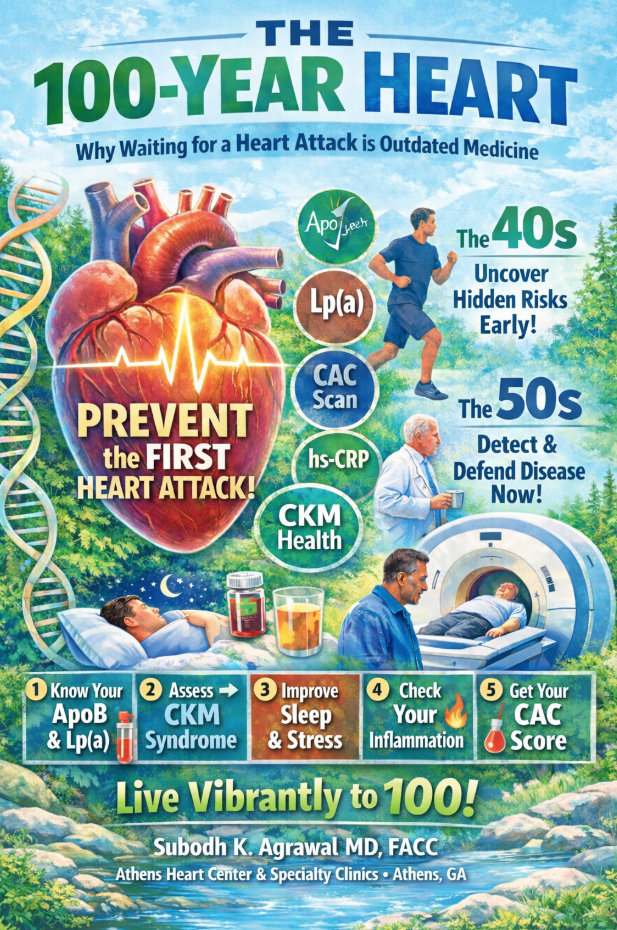
40s Risk discovery ApoB, Lipoprotein(a), metabolic markers Improve sleep, reduce stress, plant-forward diet
50s Disease detection CAC scan, hs-CRP Mediterranean diet, risk calculators, preventive therapies
Overall Goal Early detection and prevention Advanced biomarkers and imaging Reduce heart attack risk decades in advance
  1. “What is my ApoB number, and why are we still only looking at standard LDL?”
  • The Action: Demand an Apolipoprotein B (ApoB) test. Standard LDL cholesterol tests only estimate the weight of cholesterol, but ApoB measures the exact number of atherogenic (plaque-building) particles driving into your artery walls. The clinical utility of ApoB far exceeds standard LDL, and it is the most accurate way to measure your true cholesterol risk.
  1. “Have I ever been tested for Lipoprotein(a)?”
  • The Action: Request a Lipoprotein(a), or Lp(a), blood test. This is a highly destructive, inherited cholesterol particle that does not respond well to diet or exercise. The National Lipid Association and major cardiovascular guidelines now recommend that every single adult have their Lp(a) measured at least once in their lifetime. Knowing you have it allows you to aggressively lower your other risk factors.
  1. “Where do I stand on the CKM (Cardiovascular-Kidney-Metabolic) spectrum?”
  • The Action: Evaluate your waistline, blood sugar, and kidney function together. The American Heart Association recently identified CKM syndrome as a massive health threat; adults who reach age 50 without these metabolic risk factors live over a decade longer than those who have them. Protect your kidneys and metabolism now to protect your heart later.
  1. “How are my sleep architecture and chronic stress impacting my vascular health?”
  • The Action: Treat sleep as a vital sign. The American Heart Association recently added healthy sleep to its “Life’s Essential 8” guidelines because poor sleep directly drives up blood pressure, weight, and risk for Type 2 diabetes.
  1. “Is there any early evidence of inflammation in my body?”
  • The Action: Look beyond just lipids and check your general inflammatory markers. Inflammation is the fire that turns cholesterol into dangerous plaques. Adopting a high-quality, plant-forward diet early in this decade sets the foundation for a quiet, low-inflammation immune system.

The 50-Year-Old: The Decade of Precision Anatomy and Aggressive Action

By age 50, primary prevention shifts from predicting risk to actively hunting for the presence of disease. If plaque is there, we want to freeze it in its tracks before it can rupture. Ask these 5 questions:

  1. “What is my exact Coronary Artery Calcium (CAC) score?”
  • The Action: Get a CAC scan. This is a quick, painless, low-dose CT scan of your chest that physically looks for calcified plaque in your heart’s arteries. A score of zero is fantastic news, while a score over 100 means you absolutely need to be on a statin and potentially aspirin to stabilize the plaque. It takes the guesswork out of your treatment.
  1. “What is my residual inflammatory risk, specifically my hs-CRP?”
  • The Action: Ask for a high-sensitivity C-reactive protein (hs-CRP) blood test. Even if your cholesterol is perfect, high inflammation can cause a heart attack. An hs-CRP level of 2 mg/L or higher indicates increased risk, signaling that you and your doctor need to aggressively target inflammation.
  1. “Would a GLP-1 receptor agonist benefit my long-term cardiovascular risk?”
  • The Action: If you struggle with obesity or Type 2 diabetes, discuss GLP-1 medications (like semaglutide or tirzepatide) with your doctor. These medications are no longer just for weight loss; recent clinical trials prove they directly reduce the risk of major adverse cardiovascular events like heart attacks and strokes, and they are now considered a front-line preventative therapy for eligible patients.
  1. “What is my true risk using the AHA PREVENT calculator?”
  • The Action: Stop using outdated risk calculators. Ask your doctor to run your numbers through the new AHA PREVENT calculator, which estimates your 10-year and 30-year risk for heart disease by factoring in your cardiovascular, kidney, and metabolic health all at once.
  1. “Am I strictly following an evidence-based protective diet?”
  • The Action: Transition heavily into the Mediterranean diet. Extensive meta-analyses have consistently proven that high adherence to the Mediterranean diet – rich in extra-virgin olive oil, nuts, and minimally processed plants – is highly associated with a lower 10-year risk of fatal and non-fatal cardiovascular events.

The 100-Year Heart Checklist: Understanding Your Lab Results

Test What It Measures Why It Matters
LDL Cholesterol Amount of cholesterol in blood Traditional risk estimate
ApoB Number of plaque-forming particles More accurate predictor of artery damage
Lipoprotein(a) Genetic cholesterol particle Major inherited heart risk
hs-CRP Inflammation level Detects vascular inflammation risk
CAC Scan Calcified plaque in arteries Direct evidence of heart disease

The Bottom Line

You do not have to be a passive participant in your aging process. By demanding precision blood work, utilizing anatomical scans, and leveraging modern metabolic therapies, hitting your 100th birthday with a strong, healthy heart is not just a dream – it is a medical probability. Take charge of your health today.

Sources

American Heart Association (AHA)
Life’s Essential 8 and cardiovascular health guidelines
https://www.heart.org/en/healthy-living/healthy-lifestyle/lifes-essential-8

National Lipid Association
Lipoprotein(a) testing recommendations
https://www.lipid.org

Centers for Disease Control and Prevention (CDC)
Heart disease prevention and risk factors
https://www.cdc.gov/heartdisease

National Institutes of Health (NIH)
Cardiovascular disease risk and inflammation research
https://www.nih.gov

American College of Cardiology (ACC)
ApoB and advanced lipid testing insights
https://www.acc.org

AHA Scientific Statement on CKM Syndrome
Cardiovascular Kidney Metabolic syndrome overview
https://www.heart.org

National Institutes of Health (NIH) – hs-CRP and Inflammation
https://www.ncbi.nlm.nih.gov

American Diabetes Association (ADA)
GLP-1 receptor agonists and cardiovascular outcomes
https://diabetes.org

American Heart Association Journals
Mediterranean diet and cardiovascular risk reduction
https://www.ahajournals.org

Share Your Thoughts

  • Misty Ver Strat March 5, 2026

    Very insightful!! THANK YOU!

Leave a Comment

Your email address will not be published. Required fields are marked *

Scroll to Top
Book Appointment